
How Python Development Services Cut Your AI Build Time
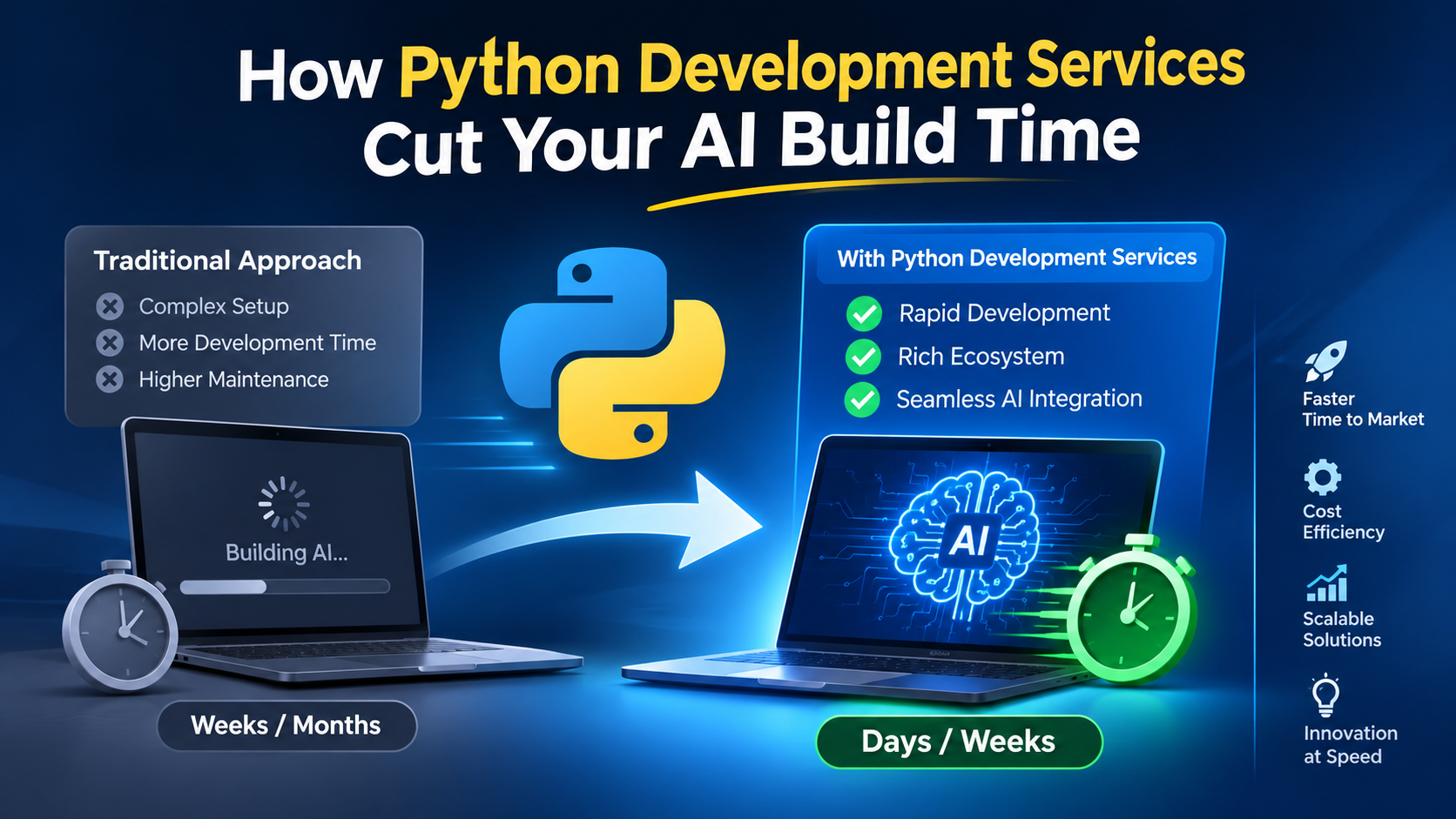
Most AI projects don't slip because the model is hard. They slip because of everything wrapped around the model. Data that lives in four systems and agrees with itself in none of them. A retrieval layer that works beautifully on the twelve test documents and falls apart on document 4,000. An inference bill nobody modelled until the finance team asked a pointed question in month three. This is where Python development services either save you a quarter or cost you one.
I've watched enough of these builds to have a strong opinion about it. The gap between a six-week AI feature and a six-month one almost never comes down to raw talent. It comes down to how much of the plumbing a team has already built before yours. That's the practical argument for working with an experienced Python Development Company instead of assembling the skill set from scratch, and it's why so many teams comparing the top Python development companies are really comparing delivery speed rather than hourly rates. If you're about to hire Python developers for an AI build, the questions below matter more than any CV you'll read this week.
The short answer
Python development services cut AI build time by removing the work that sits around the model: data pipelines, retrieval, evaluation harnesses, serving infrastructure, and cost control. An experienced Python team arrives with this scaffolding already written and tested, which typically removes four to ten weeks from a first production release compared with a team building it fresh.
The five biggest savings, in order of impact:
- Reusable pipeline and service scaffolding instead of a blank repo
- Correct library decisions made on day one rather than week three
- Parallel workstreams across data, model, and platform
- An evaluation harness built before the demo, not bolted on after launch
- Deployment designed backwards from your latency and budget limits
Where AI build time actually disappears
Ask a team how long the AI part takes and you'll hear something like three weeks. Then the project runs five months. The missing time isn't in the model code. Here's the shape I keep seeing across projects, offered as a working rule of thumb rather than a survey result:
Work item | Share of calendar time | Usually underestimated by |
Getting clean, permissioned data out of source systems | 25–35% | A lot |
Chunking, embedding, indexing, retrieval tuning | 10–15% | Quite a bit |
Prompting, fine-tuning, actual model code | 10–15% | Overestimated, oddly |
Evaluation harness and regression testing | 10–20% | Almost always |
Serving, autoscaling, latency and cost control | 15–20% | A lot |
Access control, audit logging, PII handling | 5–10% | Until legal reviews it |
Notice that the thing everyone talks about, the model work, is the smallest slice. The schedule lives or dies on the other 85 percent, and all of it is ordinary Python engineering. Pipelines, queues, retries, caching, typed interfaces, test coverage. That's the honest reason specialist Python development services move the needle on timelines: they're not better at prompting, they're faster at the unglamorous part.
Six ways experienced Python teams compress the timeline
- They've already written the boring 60 percent A team that has shipped a dozen AI features isn't starting from a blank main.py. They have an internal starting point: FastAPI service skeleton, Pydantic schemas, a job runner, structured logging, a retry and backoff policy, a vector store adapter that isn't hard-wired to one vendor, and a config layer that doesn't collapse when you add a second environment. That sounds unremarkable. It's worth two to four weeks on its own, and more importantly it's two to four weeks of work that nobody on your team has to get right on the first attempt.
- They choose the right library on day one Python's strength and its trap are the same thing. For any job there are nine libraries, three are abandoned, two are excellent, and the documentation won't tell you which. Picking wrong costs you a rewrite in week four. Concrete examples. A team that already knows Polars handles out-of-core data differently from pandas won't spend a week fighting memory on a 40GB table. A team that has run uv in CI knows your dependency resolution drops from minutes to seconds. A team that has hit the limits of a managed vector database knows at which document count you should move to pgvector or Qdrant, before you're migrating under pressure. None of this is genius. It's just scar tissue, and scar tissue is the thing you're actually buying.
- Parallel tracks, not one person doing everything in sequence One senior generalist builds the pipeline, then the retrieval, then the API, then the deployment. Each step waits for the one before. A properly staffed pod runs data engineering, model work, and platform in parallel from week one against an agreed interface contract. This is the single largest structural saving and it's the hardest to get from a single hire, however good that hire is. It's also why "hire two senior people" and "bring in a four-person pod for ten weeks" produce such different calendars even at similar cost.
- Evaluation gets built before the demo Here's my least popular opinion: if you don't have an evaluation harness before you have a demo, you don't have a project, you have a prototype with good lighting. Experienced teams write the eval loop in week one, even when it's crude. Thirty labelled examples and a scoring function beats a vibe check every time, and it's the only thing that lets you change a prompt, swap a model, or adjust chunk size without quietly breaking something.
The version that gets written in week one. It is not fancy.
It just stops you from shipping a regression you can't see.
import json from statistics import mean
def run_eval(cases_path: str, answer_fn, judge_fn) -> dict: with open(cases_path) as f: cases = [json.loads(line) for line in f]
results = []
for case in cases:
    got = answer_fn(case["question"], context=case.get("context"))
    results.append({
        "id": case["id"],
        "score": judge_fn(got, case["expected"]),
        "got": got,
    })

failures = [r for r in results if r["score"] < 0.7]
return {
    "n": len(results),
    "mean_score": round(mean(r["score"] for r in results), 3),
    "failures": failures,
}
Thirty lines. It gets written on day three by teams that have been burned, and in month four by teams that haven't. 5. Deployment is designed backwards from the constraint Amateur sequence: build it, then work out how to serve it. Experienced sequence: start from the constraint. 400ms p95, a fixed monthly inference budget, data that can't leave a particular region. Those three numbers decide your architecture, and discovering them late means rebuilding. A team that has handled it before knows when to batch, when to cache aggressively on embeddings, when a smaller fine-tuned model beats a frontier model on both cost and latency, and when the honest answer is that your requirement needs changing. 6. One language across the whole stack Python runs your ETL, your model code, your API, and your eval suite. That's unusual and it matters more than people credit. No handoff between a research notebook and a production service written in another language, no reimplementation step, no two teams arguing about whose version is correct. The notebook becomes a module, the module becomes an endpoint.
A real example, and an honest one
Instagram is the reference case I keep coming back to. Its web tier has run on Django and Python at a scale most of us will never touch, serving hundreds of millions of people, and the engineering team has published openly about the work of keeping Python fast at that size, including their Python 3 migration and their performance tooling. When someone tells me Python can't hold up in production, that's usually the end of the conversation.
Closer to the ground, here's a composite from projects I've seen rather than a single named client. A mid-sized insurance operations team wanted to triage inbound claim documents. Their first internal attempt ran fourteen weeks and stalled, not because the extraction was hard, but because nobody owned the ingestion from their document store, the eval set didn't exist, and the Streamlit prototype couldn't survive ten concurrent users. The second attempt, with a Python team that brought its own pipeline scaffolding and eval tooling, reached production in five weeks. Same problem. Same models. Different starting line.
I'd encourage you to replace this paragraph with a case of your own before publishing, because specific, verifiable stories outperform composites every time.
In-house, agency, or hybrid: the honest comparison
Factor | Hire in-house | Python development company | Hybrid pod |
Time to first commit | 8–14 weeks (search plus notice) | 1–2 weeks | 1–2 weeks |
Starting scaffolding | None | Reusable, battle-tested | Reusable |
Cost shape | Fixed, long-term | Variable, project-based | Mostly variable |
Domain knowledge | Deep, accumulates | Shallow at first | Deep plus broad |
Risk if someone leaves | High | Low, team absorbs it | Low |
Best for | Core, permanent capability | Fixed-scope builds, deadlines | Shipping now and building capability |
My view: the hybrid is underrated. One or two of your own engineers embedded in an external pod gives you the delivery speed and keeps the knowledge in the building after the engagement ends. Pure outsourcing leaves you dependent. Pure in-house hiring is correct for your long-term core, and painfully slow when you have a date to hit.
How to evaluate a Python development company
Most comparison articles will tell you to check portfolios and reviews. Useful, but weak. These are the factors that actually predict delivery:
Ask for the repo tour, not the case study. Request a walkthrough of a sanitised project repo. You're looking for type hints, a real test suite, dependency pinning, CI that runs on every push, and a README a new engineer could follow. Five minutes of this tells you more than a twenty-slide deck.
Check if they argue with you. A team that accepts your spec without challenge is a team that will build the wrong thing on schedule. The good ones push back in the first call, usually on scope or on your latency assumption.
Ask who writes the evals. If evaluation sits with QA at the end, walk away. It belongs to whoever writes the feature.
Look for production MLOps, not just model work. Have they run inference services under real load? Can they talk specifically about cold starts, batching, GPU scheduling, token cost per request? Vague answers here are the single most reliable warning sign.
Confirm the handover plan on day one. Documentation, runbooks, and a knowledge transfer window should be in the statement of work, not a favour you request at the end.
Match the team to the phase. A discovery-stage build needs generalists who move fast. A scale-up build needs platform depth. The best firms will tell you which one you need, even when it's the smaller engagement.
A simple scoring approach: rate each of those six from 1 to 5, and treat anything under 22 out of 30 as a serious conversation before you sign.
What to ask before you hire Python developers
Skip the algorithm puzzles. For AI work, these questions sort candidates and vendors faster:
- Describe a time your retrieval quality dropped after a data change. How did you detect it? (If the answer is "a user told us", that's the answer.)
- Walk me through your last inference cost reduction. What did you measure and what did you change?
- When would you not use a vector database?
- How do you handle a model upgrade without breaking existing behaviour?
- Show me how you'd structure a Python service that needs to call three models with different latency profiles.
- What's in your pyproject.toml and why?
For a paid trial task, I'd give a small, messy, real dataset and ask for an ingestion pipeline plus an eval set. Two days of that is worth four interviews. You learn whether they ask clarifying questions, whether they write tests unprompted, and whether they tell you when the data is unusable.
What's changed going into 2026
Some of this genuinely affects your build time, which is why it belongs in the conversation rather than in a trends listicle.
Free-threaded Python is now a real option. Free-threading became officially supported in Python 3.14 (PEP 779) after its experimental run in 3.13, and the macOS binaries now ship free-threading support by default in 3.15. For CPU-bound preprocessing and embedding workloads, this changes the "just use multiprocessing" reflex. Worth checking your C extension dependencies declare GIL safety before you move production workloads across.
Python 3.15 landed in October 2026 with explicit lazy imports (PEP 810), a frozendict builtin, a new sampling profiler called Tachyon under a dedicated profiling package, and a faster JIT. Lazy imports matter more than they sound for anyone running Python in serverless or short-lived workers, because import time is a real share of cold start.
Ecosystem support lags the release, every year. Around the 3.15 release candidate, only a small fraction of the top PyPI packages had declared 3.15 support, with several major ones still catching up. Any team that tells you to jump to the newest version immediately on a deadline project hasn't been burned yet. Current minus one is usually the right production call.
Tooling consolidated. uv for environments and packaging, ruff for linting and formatting, Pydantic for boundaries, Polars where pandas strains. A team already standardised on this stack spends noticeably less time on setup and CI than one still assembling it per project.
Evaluation-driven development is becoming the norm. The teams shipping reliable AI features write the eval set before the feature, the same way test-driven development works. This is the biggest cultural shift I've seen in AI engineering over the last two years, and it's the practice I'd screen hardest for.
Smaller fine-tuned models keep winning on narrow tasks. For classification, extraction, and routing, a small fine-tuned model often beats a large general one on cost, latency, and consistency. Teams that only reach for the biggest available model are leaving a lot of budget on the table.
Red flags that quietly add months
- No eval strategy in the proposal
- A Jupyter notebook presented as the deliverable
- No mention of data access or permissioning in week one planning
- Fixed-price quotes on a scope nobody has explored yet
- A single senior name on the proposal and juniors on the project
- Nobody asks about your latency or budget limits in the first call
- "We'll figure out deployment later"
Any two of these together and I'd expect the timeline to roughly double.
Frequently asked questions
How much time do Python development services actually save on an AI build?
In practice, four to ten weeks on a first production release. The saving comes from pre-built pipeline and service scaffolding, correct library decisions made immediately, and parallel workstreams instead of sequential ones.
Why is Python the default language for AI development?
Because the entire tooling chain is there: PyTorch, Hugging Face, LangChain, Polars, FastAPI, and official SDKs from every major model provider. It also runs the data layer, the model layer, and the serving layer in one language, which removes the handoff between research and production code.
Should I hire Python developers in-house or work with a Python development company?
Hire in-house for capability you'll need permanently. Work with a company when you have a fixed scope and a date, because the time to first commit is roughly one to two weeks against eight to fourteen for a hire. A hybrid pod with one or two of your own engineers embedded gives you both.
What should I look for in the top Python development companies?
Production MLOps experience, a sanitised repo you can inspect, evaluation ownership sitting with the engineers, a written handover plan, and a willingness to challenge your spec in the first call. Portfolios and review scores are weaker predictors than any of these.
How long does a typical AI feature take with an experienced Python team?
A scoped retrieval or extraction feature usually runs six to ten weeks to production, including the evaluation harness and deployment. Anything promised in two weeks is a prototype, which is fine as long as everyone calls it that.
What's the most common reason AI projects run over schedule?
Data access and evaluation, in that order. Model work is consistently the smallest part of the timeline and the part teams plan for most carefully.
Is Python fast enough for production AI workloads?
Yes, for the overwhelming majority of workloads, because the heavy numerical work runs in optimised C and CUDA underneath. Free-threading support from Python 3.14 onwards also removes a long-standing limit on CPU-bound parallel work.
Where this leaves you
If you take one thing from this: judge a Python partner on the 85 percent, not the 15 percent. Anyone can demo a prompt. The teams that hit dates are the ones who've already solved ingestion, evaluation, and serving, and who'll tell you about your latency budget before you've finished describing the feature.
That's the lens we apply at WebClues Infotech when scoping AI builds, and it's the same lens I'd use to assess anyone else you're considering. If you're mapping out options, it's worth reading through how Python development companies structure AI engagements before you commit to a model, because the engagement shape tends to decide the timeline more than the team size does.
Comments
Join the discussionNo comments yet. Be the first to comment.