
AI Integration Services Comparison: Enterprise vs. Startup Needs
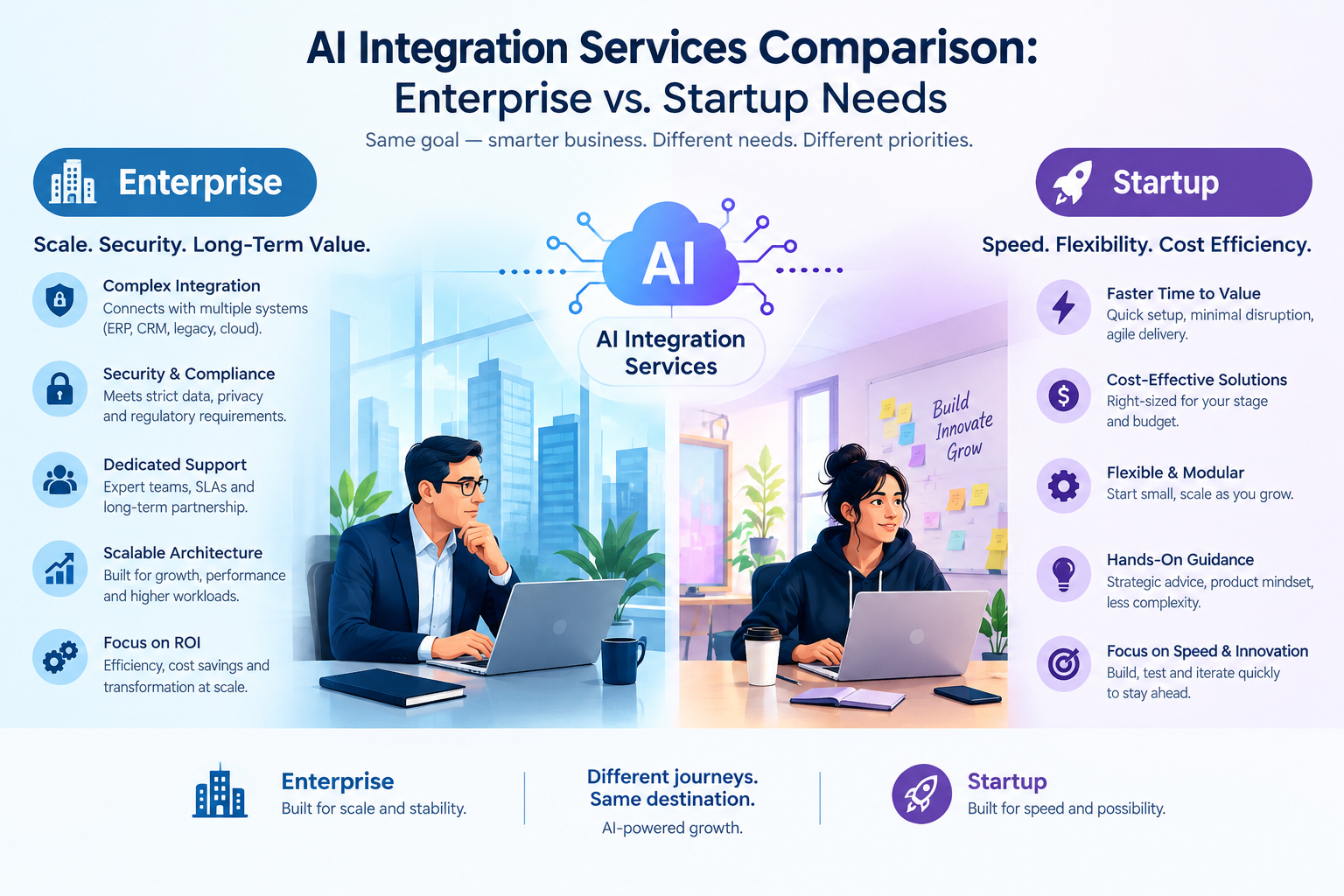
This divergence creates a critical problem: AI integration services aren't one-size-fits-all, yet many providers market themselves as if they were. Choosing the wrong AI integration company—one optimized for a different organizational context—leads to misaligned expectations, wasted resources, and implementations that don't fit how your organization actually operates.
Understanding these differences helps both enterprises and startups select partners whose strengths match their specific needs.
The Core Differences in AI Integration Requirements
Before evaluating specific service offerings, it's essential to understand how enterprise and startup contexts create fundamentally different integration challenges.
Scale and Complexity
Enterprise reality: Large organizations typically operate dozens of interconnected systems accumulated over decades. ERP platforms, CRM systems, data warehouses, and custom applications form a complex web. AI integration must navigate this complexity, connecting new capabilities to existing infrastructure without disrupting operations that generate millions in daily revenue.
Startup reality: Startups usually work with modern, cloud-native stacks with fewer integration points. The challenge isn't complexity—it's building the right foundation from the start while maintaining the agility to pivot as the business evolves.
Risk Tolerance and Speed
Enterprise reality: Enterprises prioritize stability. A failed AI deployment affecting customer-facing operations could mean regulatory scrutiny, brand damage, and significant financial impact. This necessitates extensive testing, phased rollouts, and comprehensive fallback procedures.
Startup reality: Startups often operate with higher risk tolerance because speed-to-market determines survival. The cost of moving slowly—losing to competitors, running out of runway—frequently outweighs the risk of imperfect implementations that can be refined over time.
Budget and Resource Constraints
Enterprise reality: Larger budgets enable comprehensive solutions but require extensive justification through procurement processes, business cases, and multi-stakeholder approval. Timeline from initial interest to contract signing often spans months.
Startup reality: Limited budgets demand maximum value per dollar. Startups need partners who can deliver meaningful capability quickly without requiring enterprise-scale investments. Decision-making is faster, but resources constrain what's possible.
What Enterprises Need from AI Integration Services
Enterprise AI integration demands capabilities that address large-scale operational realities. The top AI integration companies serving enterprise clients typically excel in these areas.
Legacy System Integration Expertise
Most enterprises can't simply replace existing systems. AI must integrate with mainframes, on-premise databases, and applications that have been running for decades. This requires partners with experience building bridges between modern AI capabilities and legacy infrastructure—often involving custom middleware, API layers, and careful data synchronization.
Compliance and Governance Frameworks
The EU AI Act enforcement in 2025 and expanding global regulations make compliance non-negotiable for enterprises. Partners must understand documentation requirements, audit trails, model governance, and risk classification. They need established frameworks for ensuring AI systems meet regulatory requirements across multiple jurisdictions.
Change Management at Scale
Deploying AI to thousands of users requires systematic change management: training programs, documentation, support systems, and strategies for overcoming resistance. Enterprise-focused AI integration partners bring organizational change expertise alongside technical capabilities.
Enterprise-Grade Security
Data security requirements in enterprise contexts are stringent. Partners must demonstrate SOC 2 compliance, understand data residency requirements, implement robust access controls, and architect solutions that protect sensitive information while enabling AI capabilities.
What Startups Need from AI Integration Services
Startup AI integration priorities look quite different. The right AI integration company for a startup brings capabilities aligned with growth-stage realities.
Speed and Agility
Startups need partners who can move at startup pace. This means rapid prototyping, iterative development, and willingness to adjust direction as product-market fit evolves. Multi-month discovery phases and lengthy documentation cycles don't work for organizations racing to establish market position.
Cost-Effective Approaches
Budget constraints require creative solutions. Startup-oriented partners excel at leveraging managed services, pre-built components, and efficient architectures that deliver capability without enterprise-scale investment. They understand how to phase implementations to match funding milestones.
Scalable Architecture from Day One
While startups need lean implementations now, smart architecture decisions prevent costly rebuilds later. Good partners design systems that handle current volumes efficiently while providing clear scaling paths as the business grows—avoiding both premature optimization and technical debt that creates future constraints.
Strategic Technology Guidance
Startups often lack deep in-house AI expertise. Beyond implementation, they benefit from partners who provide strategic guidance: which AI capabilities will differentiate the product, what's possible within budget constraints, and how emerging technologies like agentic AI and multimodal systems might create future opportunities.
2026 AI Trends Affecting Both Enterprises and Startups
Several current trends shape AI integration services across both segments, though with different implications.
Agentic AI Adoption
For enterprises: Agentic AI enables sophisticated automation of complex workflows spanning multiple systems. Implementation requires robust governance frameworks and careful integration with existing process orchestration.
For startups: Agentic capabilities can create dramatic differentiation, enabling products that accomplish tasks competitors can't match. The opportunity lies in building agentic features that define the product's value proposition.
Democratized AI Tools
For enterprises: Accessible AI tools enable citizen developers but create governance challenges. Integration partners help establish appropriate guardrails while enabling business-led innovation.
For startups: Democratized tools reduce the technical barriers to AI adoption, but achieving differentiation requires going beyond what anyone can access. Partners help identify where custom development creates defensible advantage.
Multimodal AI Capabilities
For enterprises: Processing diverse data types—text, images, audio, video—simultaneously opens new automation possibilities across customer service, operations, and analytics.
For startups: Multimodal AI can enable entirely new product categories. Startups can build experiences that weren't possible until recently, creating first-mover advantages in emerging niches.
How to Choose the Right AI Integration Partner for Your Context
Selection criteria should reflect your organizational reality.
For Enterprises: Evaluation Priorities
Prioritize partners with demonstrated enterprise experience—documented implementations at similar scale, familiarity with your industry's regulatory requirements, and established security credentials. Verify their change management capabilities and ability to work within enterprise procurement and governance processes. The top AI integration companies for 2026 serving enterprises maintain robust compliance frameworks and can navigate complex organizational dynamics.
For Startups: Evaluation Priorities
Look for partners experienced with growth-stage companies who understand resource constraints and urgency. Assess their flexibility—can they adjust scope and approach as your needs evolve? Evaluate their strategic perspective—do they understand the competitive landscape and how AI creates differentiation? Seek partners who treat your success as their success, invested in outcomes rather than simply billing hours.
Frequently Asked Questions
Can startups work with AI integration companies that primarily serve enterprises?
It's possible but often suboptimal. Enterprise-focused partners typically have higher minimum engagement sizes, longer timelines, and processes designed for larger organizations. Some maintain separate practice areas for growth-stage companies, which can work well. The key is ensuring the specific team assigned understands startup constraints and can adapt their approach accordingly.
How much should startups budget for AI integration services?
Initial AI integration for startups typically ranges from $30,000 to $150,000 depending on scope and complexity. Focused implementations leveraging managed services and pre-built components fall toward the lower end. More custom development or complex integration requirements push higher. Phase implementations to match funding milestones—initial capability now, expanded features as resources allow.
What's the typical timeline difference between enterprise and startup AI implementations?
Startups can often deploy initial AI capabilities in 6-12 weeks with the right partner. Enterprise implementations typically span 4-12 months minimum, driven by more extensive integration requirements, compliance needs, and organizational processes. The complexity gap, not just the scale gap, drives timeline differences.
Should enterprises consider startup-focused AI integration partners?
Generally no, for core enterprise initiatives. Startup-focused partners often lack the compliance frameworks, security certifications, and enterprise integration experience that large organizations require. However, enterprises sometimes engage smaller partners for innovation projects or proofs-of-concept where speed matters more than scale—then transition to enterprise partners for production deployment.
How do pricing models differ between enterprise and startup AI integration services?
Enterprise engagements often use time-and-materials or milestone-based pricing for complex, evolving projects. Startup engagements more frequently feature fixed-price packages, outcome-based arrangements, or equity participation in early-stage companies. Some partners offer deferred payment structures or success-fee models aligned with startup funding cycles.
Matching Partner Capabilities to Your Reality
The best AI integration outcome emerges from alignment between partner capabilities and organizational context. Enterprises need partners who understand scale, compliance, and organizational complexity. Startups need partners who move fast, work within constraints, and contribute strategically to product development.
Neither context is inherently better or worse—they're simply different. The mistake is selecting a partner optimized for a different reality than yours, then struggling with the mismatch throughout the engagement.
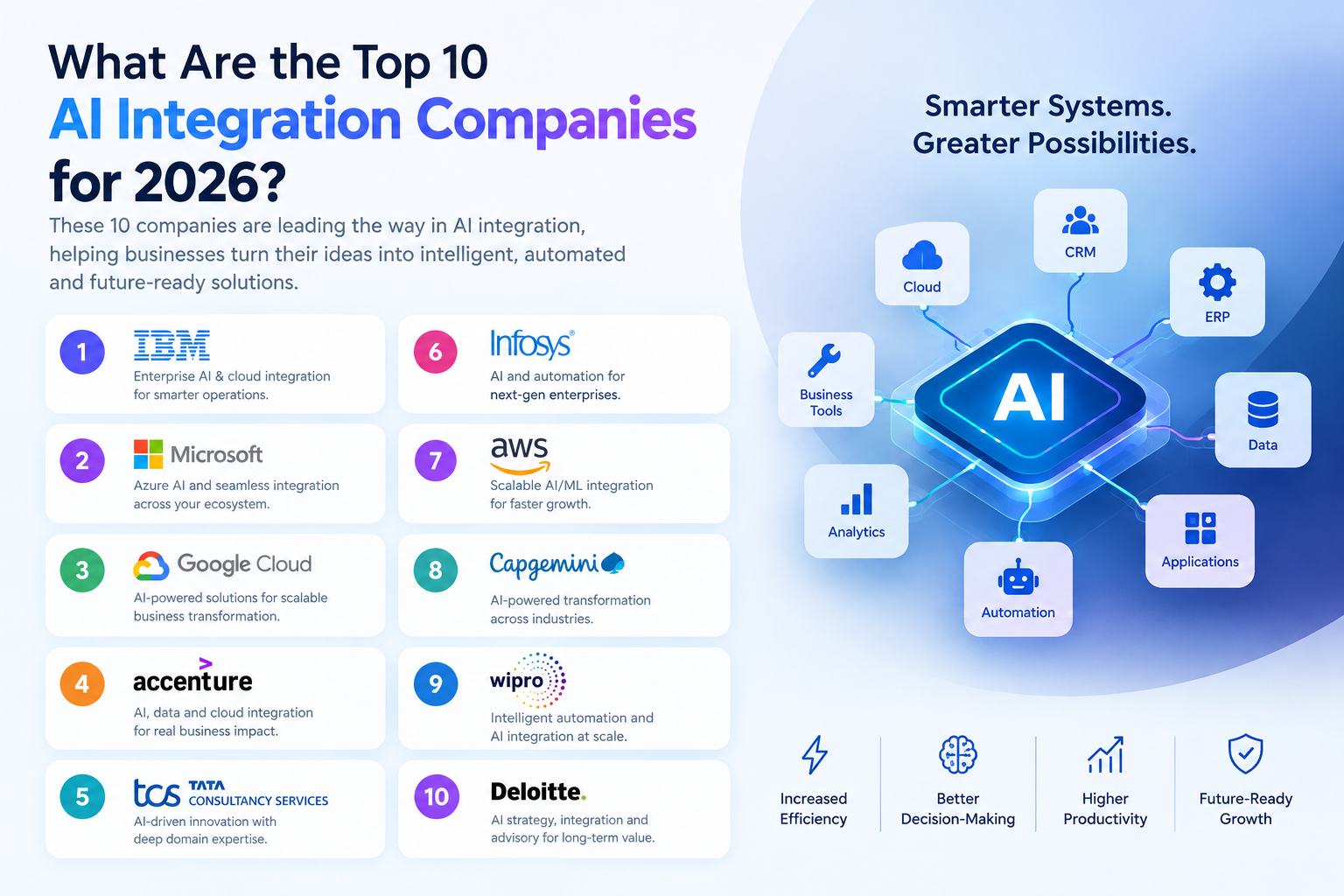
As you evaluate potential partners, understanding which providers excel in your specific context matters as much as their overall reputation. Reviewing the top 10 AI integration companies for 2026 with your specific requirements in mind—enterprise or startup—helps identify partners whose strengths align with what your organization actually needs.
The right AI integration partner doesn't just deliver technology—they understand your operational reality and deliver solutions that work within it. That contextual fit ultimately determines whether AI integration accelerates your success or creates friction that slows you down.