
MERN Development Solutions vs. LAMP Stack: A Clear Comparison
You are not alone if your business is based on Linux, Apache, MySQL, and PHP. The LAMP stack has been used to run the internet in the past 20 years and continues to serve millions of production applications globally. It is practical, tested and true.
No longer, however, will many applications that businesses will be required to develop in 2026 be functional. The demands of real-time capabilities, integration with AI, up-to-date user interfaces, and scalable architectures have established demands that the LAMP stack was not originally intended to fulfill. Only these demands led to the creation of the MERN stack which is comprised of MongoDB, Express.js, React, and Node.js.
This guide is an open source comparison between the two stacks, and where each does best, and helps you determine whether your next project or your current application is either on MERN or LAMP, or whether a planned migration between the two is necessary.
Knowing What Each Stack Entails.
The LAMP Stack
LAMP is a Linux based operating system which is combined with Apache web server, MySQL relational database and the php server-side language. It has a conventional request-response pattern: the browser requests a page, the server executes it with PHP, calls MySQL and provides rendered HTML. It is the architecture on which WordPress, Drupal, Larval, and thousands of custom applications are implemented.
The MERN Stack
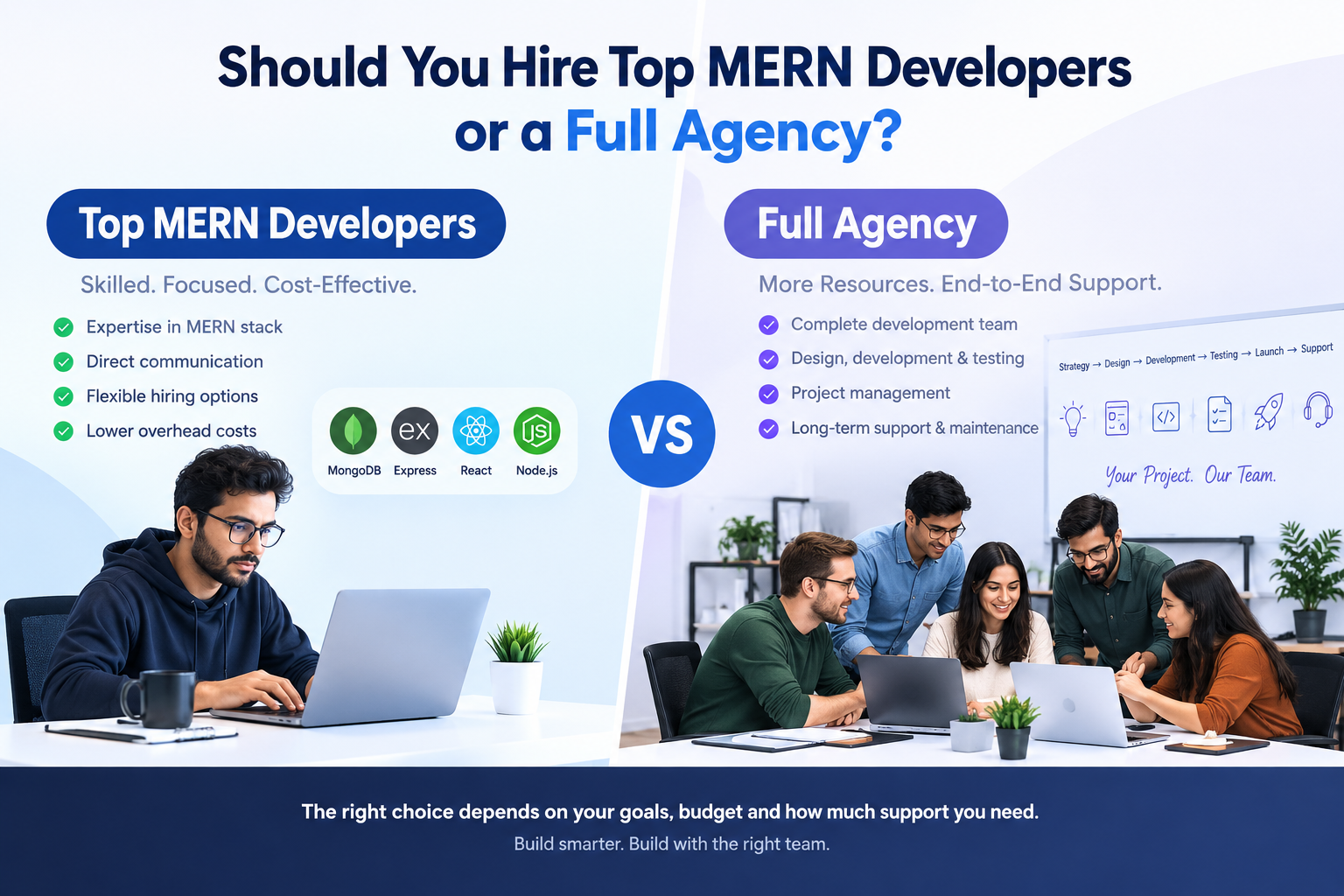
MERN is an amalgamation of MongoDB document database, Express.js backend framework, React frontend library, and Node.js server runtime. It is built on JavaScript on all layers, is a first-class citizen of real-time communication and runs user interfaces as dynamic single-page applications or as high-rendered hybrid applications with frameworks such as Next.js.
Head-to-Head Comparison
Application Architecture
LAMP adheres to an old-fashioned multi-page application model. Every user action will be a complete page request to the server that will render HTML and send it back. Although dynamic behavior can be added with AJAX techniques, the basic architecture was built around document-oriented web pages as opposed to an interactive application.
MERN is designed to support single-page and hybrid applications with the frontend maintaining state by itself, making API calls to the backend, and dynamically changing the interface without loading an entire page. This architecture generates a quicker, faster-resolving user experiences that seem to be native applications as opposed to web pages.
Ruling: MERN prevails in interactive, application-type experiences. LAMP is still sufficient in case of content-related websites that are not very interactive.
Real-Time Capabilities
LAMP did not intend to be real time communication. PHP is stateless, does not support long connections. To add such features as live chat, real-time notifications, collaborative editing, or streaming updates, it is necessary to add separate services to the LAMP architecture itself.
MERN is natively real-time. The WebSocket connections under node.js are persistent and effective to support live data streaming, instant notifications, collaborative functionalities, and real-time dashboards as a part of the basic stack. There is no need of any other services or workaround in architecture.
Conclusions: MERN is the clear choice when it comes to any application that needs real-time features.
AI Integration
LAMP can interact with AI services via API calls via PHP, though integration is not comprehensive. PHP does not have a native AI ecosystem, integrating LLM responses into the frontend can only be done via workarounds, and developing AI-native functionality in a LAMP application is more of a battle with the architecture than a battle against it.
MERN is a natural combination with AI. MongoDB Atlas Vector Search is used to create semantic search and retrieval-augmented generation on the existing database. Node.js is efficient in responding to asynchronous calls of AI API and streams. React makes AI-generated content displayed with progressive display patterns. The whole process of AI integration is executed through the intrinsic functionality of the stack.
In teams constructing AI-integrated applications, the AI computation layer can typically be Python services irrespective of the web stack. Top Python development company analysis gives background on companies that deliver MERN frontend and Python-based AI backends - a new architecture that is becoming popular in intelligent web apps.
Ruling: MERN in favor of AI-integrated applications. LAMP has the ability to ingest simple AI APIs, but does not support the streaming, real-time and vector search patterns that the current AI capabilities demand.
Database Flexibility
MySQL (LAMP) is a relational database that is good at structured, tabular data, with defined relationships. It is strict with schemas, which offer data integrity assurances that certain applications must have. Nonetheless, application migrations to a schema introduce development costs, and MySQL does not support unstructured data and flexible schema as well as document databases.
MongoDB (MERN) is a storage database that is flexible and stores data as JSON-like documents that can have different forms in various records. This flexibility speeds up the development process when requirements change rapidly - typical in startups and products in the process of finding product-market fit. MongoDB also offers native time series collections, change streams and vector search, which MySQL does not.
Verdict: MySQL prevails in applications having rigid and defined relational data. MongoDB is a winner in terms of evolving applications, flexible schemas, and AI-related features that need a vector search.
Hiring and Talent Development of the developer.
The pool of talent is aging and LAMP has a significant number of existing developers. There are fewer new developers who use PHP as their language of choice, and older PHP developers are moving towards more and more towards JavaScript or Python ecosystems. It is possible to hire to maintain LAMP. It is becoming difficult to hire the best talent to develop new LAMP.
MERN enjoys the popularity of JavaScript as the most popular programming language. React and Node.js are always among the most demanded developer skills. It has a large pool of talent, which is increasing and is being filled by younger developers in the market.
Ruling: MERN possesses a better, expanding talent pool. The talent of LAMP is present and shrinking.
Performance at Scale
LAMP is vertically scalable - it is possible to add more resources to one server. Horizontal scaling can be implemented, but it is more complex to architecturally implement than the stack was. The process-per-request model used by PHP incurs more memory when highly concurrent than event-driven models.
MERN is more naturally scaled horizontally. Node.js supports thousands of parallel connections, with little memory usage. MongoDB has the ability to shard distributed data over multiple servers. Containerized MERN deployments are automatically scaled on-demand using typical orchestration tools.
Conclusion: MERN is more effective in high-concurrency and horizontal scaling. LAMP is suitable in moderate traffic, but is architecturally strained at scale.
When LAMP Still Makes Sense
LAMP is not old-fashioned. Under certain conditions, it is still a viable option.
Content management websites. The WordPress, which is the most popular CMS of the world, runs on LAMP. In the case of blogs, marketing sites, and content-driven sites where the most important task is publishing and displaying content, LAMP with WordPress is a cheap, well-supported option.
Available LAMP applications that are effective. When your existing LAMP application is capable of meeting business expectations, is adequate and does not require real-time functionality or AI integration, migration due to modernity is a waste of resources. Keep it until there is a need to change.
Basic CRUD programs using relational data. LAMP is fine with applications that mostly create, read, update and delete structured records with well-defined relationships and which do not require real-time or AI functionality.
In cases where MERN is the obvious solution.
In the majority of new application development in 2026, the MERN development solutions will provide benefits that LAMP is not able to provide.
Any app-like (interactive) user experience. On MERN can be dashboards, SaaS solutions, social capabilities, marketplace apps, and any other tool to be used by the user on a continual rather than a passive basis.
Applications that need real-time capabilities. Native MERN features such as live chat, collaboration, notifications, streaming data, and real-time updates can be implemented through architectural workarounds to be implemented in LAMP.
AI-integrated products. Semantic search, conversational AI, recommendation engines, content generation, and agentic AI dashboards can all be naturally integrated into the MERN stack.
Scale-based products. Applications that require a high level of traffic growth, are advantageous to MERNs event-driven concurrency model and horizontal scaling architecture.
Switching to MERN.
Migration is a viable alternative in case of limitations with your current LAMP application that are noted in this comparison.
Begin with the frontend. Substitute the PHP-rendered pages with a React frontend, which interacts with your current PHP backend via APIs. This provides user experience benefits without reworking the backend.
Gradually migrate the backend. Migration of PHP services to Node.js and Express (one by one) with the most critical performance endpoints or AI-relevant endpoints first. The gradual nature of this process minimizes the risk, and validation is possible at every step.
Migration of the database. All the tables do not have to be transferred to MongoDB. Move data with flexible schema or which needs to be searched as vectors. Store relational data in MySQL when it is working. Numerous production applications have both databases running concurrently.
Frequently Asked Questions
Will MERN be better than LAMP in 2026?
Yes on most new applications. MERN offers better real-time performance, greater integration of AI, more user-friendly interfaces, and scalability. LAMP is still applicable to content management websites, applications that are already in existence, and applications with simple CRUD databases that have only relational data.
Is it possible to migrate LAMP to MERN?
Yes. Incremental is the best way, beginning with a React frontend, gradually replacing PHP services at the backend with Node.js, and carefully transferring data to MongoDB where it can enjoy the flexibility of schema or a vector search. Full migrations can last three to nine months based on the complexity of the application.
What is the cost of development of MERN versus LAMP?
MERN developer rates are similar or a notch above PHP developer rates, with offshore rates ranging from 35 to 95, and US or European talent ranging in 100 to 220 per hour. Interactive application MERN projects have an estimated cost of $30,000 to 175,000. The increased competency of MERN developers tends to generate lower total project costs due to quicker delivery, and less architectural workarounds.
Is the LAMP stack still supported?
Yes. PHP is being updated, MySQL is being actively developed by Oracle, Apache is, and Linux is the operating system of the server. LAMP stack will not be abandoned. Nonetheless, its eco system has reached a stagnation whereas that of MERN keeps on growing, especially in terms of AI and real time development.
Which developers to choose in a new project MERN stack or PHP?
In 2026, new projects should be hired to MERN stack developers unless your project is a content management site only or a simple CRUD application with only relational data. MERN offers the interactive, real-time and AI-ready features that most modern applications need.
Making a decision based on the destination of your product.
The internet that is present today was created using the LAMP stack. With the MERN stack, the applications that determine its destination, interactive, real-time, intelligent, and scalable are being built.
Assuming that your app will require any of those attributes either now or in the near future, MERN development solutions offer the framework that corresponds to the requirements. Select the stack you are going to, not the one the industry was ten years ago.