
How Python Development Services Accelerate ML Product Launches
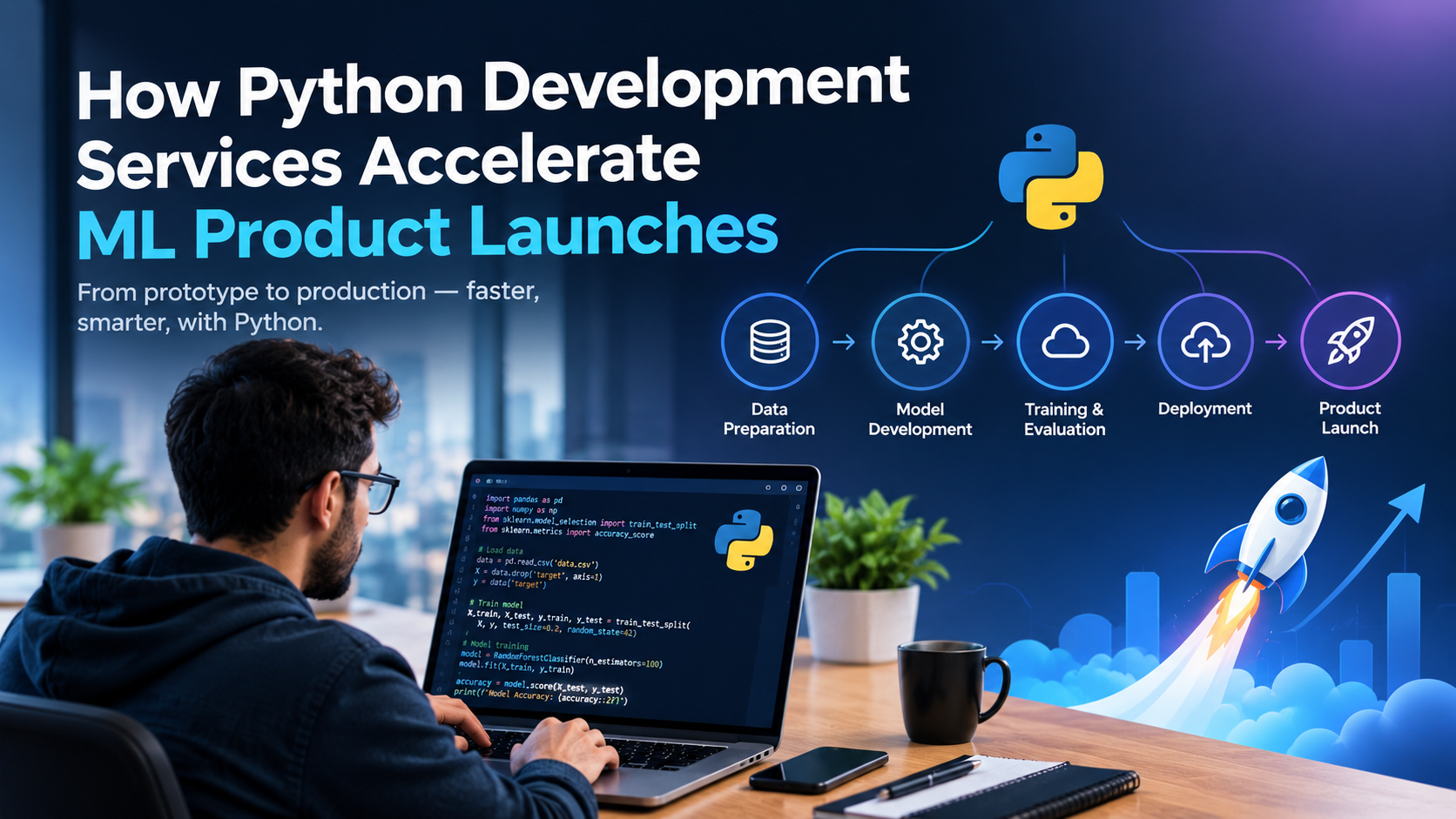
In 2026, the bottleneck for shipping machine learning products is rarely the model. It is the engineering around it, and that is where Python development services earn their keep.
Most teams discover the same hard truth eventually: a working model in a notebook is maybe 20% of an ML product. The other 80%, the data pipelines, the APIs, the deployment, the monitoring, the retraining loops, is software engineering. And in the ML world, that engineering is overwhelmingly written in Python. This is why the choice of Python development partner has quietly become one of the biggest levers on how fast an ML product actually reaches users.
This guide explains exactly how Python development services compress ML launch timelines, the 2026 trends reshaping the work, and how to evaluate a partner so you accelerate delivery instead of inheriting technical debt.
Why Python Sits at the Center of ML Product Launches
Python is the default language of machine learning for a practical reason: the entire modern ML ecosystem, from data tooling to model frameworks to deployment libraries, is built in and around it.
That gravitational pull matters for launches. When your data scientists prototype in Python and your engineers ship in Python, the handoff between research and production stops being a rewrite and becomes a refinement. There is no costly translation step from one language to another, which is exactly where many ML projects stall for months. Strong Python development services exploit this single-language continuity to move a model from experiment to live product without re-engineering it from scratch.
How Python Development Services Compress the Timeline
A capable Python team accelerates an ML launch in four concrete ways.
- They build the data pipeline that the model actually needs Most ML delays trace back to data, not the algorithm. Experienced Python developers build reliable ingestion, cleaning, and feature pipelines so the model receives consistent, production-grade inputs. This work, often the least glamorous part of the project, is where the largest time savings hide.
- They turn a model into a deployable service A model becomes a product only when something can call it. Python developers wrap models in well-structured APIs (FastAPI and similar frameworks), handle versioning, scaling, and latency, and make the model consumable by the rest of your stack. Done well, this is the difference between a demo and a service that survives real traffic.
- They build the MLOps loop Launching is not the finish line; it is the start of the maintenance burden. Mature Python development services set up monitoring, automated retraining, and CI/CD so the model keeps performing as data drifts. Without this, ML products quietly degrade after launch and erode the trust they earned.
- They prevent the rewrite Because prototyping and production share a language, a strong team refines research code into production code rather than rebuilding it. That continuity alone can cut weeks or months off a launch. The takeaway: The fastest path to an ML launch is rarely a better model. It is disciplined Python engineering around the model you already have. The 2026 Trends Reshaping Python ML Work
The role of a Python development partner has shifted noticeably this year, and it changes what "fast" even means.
Agentic AI is moving into production systems
Agentic AI, systems that plan and execute multi-step tasks across tools, is one of the defining shifts of 2026, and these systems are built and orchestrated in Python. Launching an agentic product raises the engineering bar: it demands careful tool integration, guardrails, state management, and observability. A partner experienced here ships these systems safely; an inexperienced one ships unpredictable behavior into production.
AI-assisted development has changed delivery speed
Python developers now use AI coding assistants to handle a large share of routine implementation, accelerating pipeline and API work dramatically. The value of a senior developer has shifted from typing code toward directing these tools, reviewing their output critically, and owning architecture and correctness. When you evaluate a team in 2026, how well they wield AI tooling is now a core competency, not a side note.
Enterprise adoption raised the quality bar
As ML products move from experiments to revenue-bearing systems, expectations around security, testing, scalability, and governance have climbed sharply. Clean architecture and reproducibility are no longer optional. A team that cannot speak to these is a liability on anything beyond a prototype.
Automation now spans the whole ML lifecycle
Intelligent automation in 2026 covers entire workflows, automated data validation, continuous training, and self-healing pipelines, rather than isolated scripts. Building these end-to-end requires deep Python and infrastructure fluency, a combination rarer than vendor marketing suggests.
How to Evaluate a Python Development Company
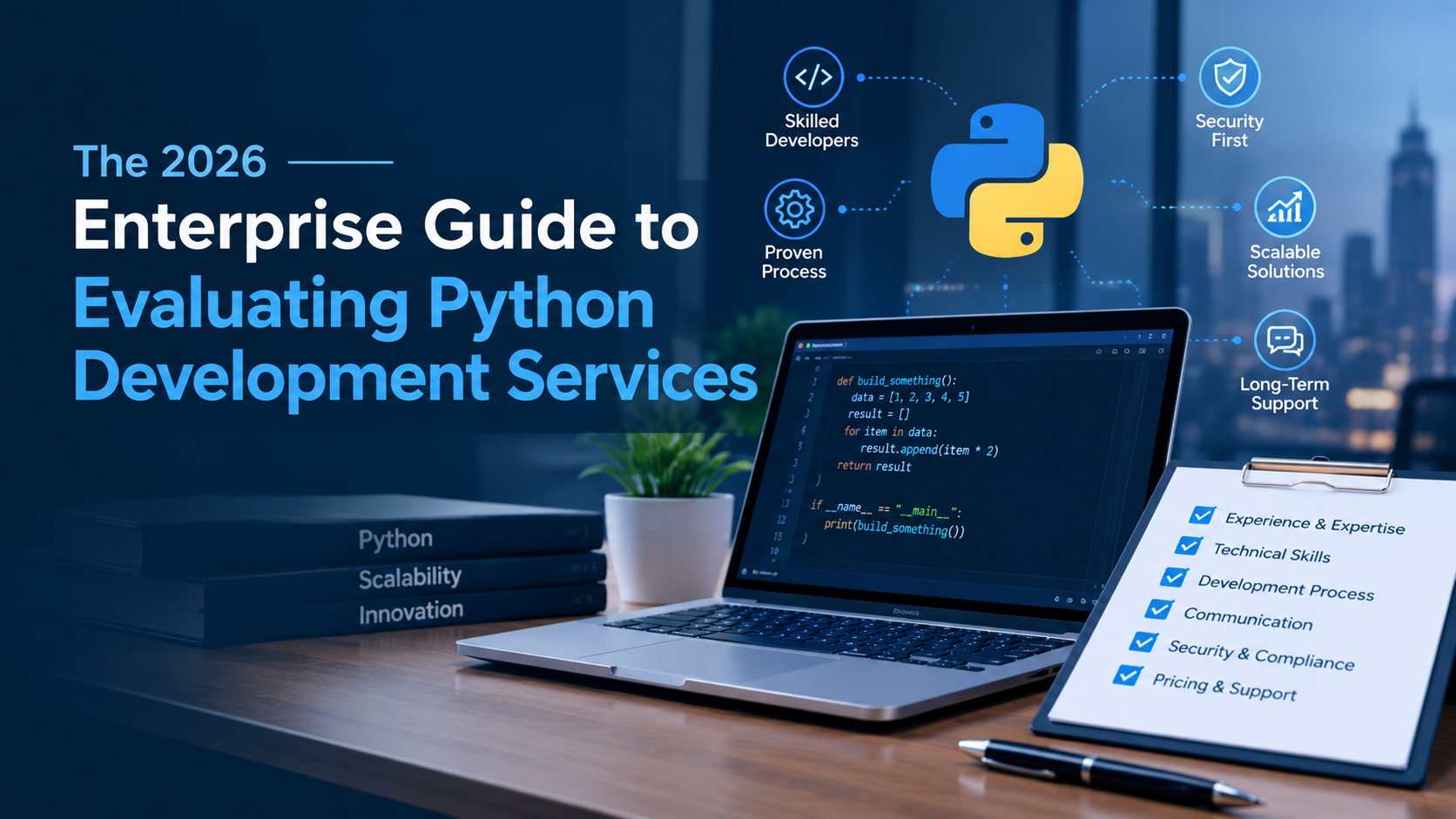
When you compare options, use a clear set of criteria rather than reacting to impressive demos. A strong partner should clear most of these convincingly.
ML and MLOps depth. Look for real production ML experience, not just web development with a data science add-on. Ask specifically about deployment, monitoring, and retraining, the parts that determine whether a launch sticks.
Data engineering capability. Since data is where most projects stall, probe their experience building reliable pipelines at scale.
Modern Python and API skills. Expect fluency with current frameworks, async patterns, FastAPI-style services, and clean, testable code.
AI-era working skills. Evidence they use AI assistants and agentic tools effectively, fast without being careless, and can catch where generated code is wrong or insecure.
Governance and reliability. A real testing habit, security awareness, reproducibility, and a point of view on model risk.
Communication and process. Clear async communication, and a track record of shipping you can actually inspect.
It is worth knowing the red flags too. Be wary of teams that lead with their tooling rather than your problem, that have no MLOps story, that treat testing as an afterthought, or that quote a fixed price with no discovery phase. Reputable providers scope before they commit.
Choosing a Hiring Model
Once you know what to look for, the next decision is how to engage. A freelancer suits small, well-defined tasks with low coordination needs. An in-house hire makes sense when ML work is continuous and central to the business and you can support a full-time engineer. A Python development company is the right call for production ML products that need reliability, scalability, MLOps, and long-term maintenance, because a company brings redundancy, established process, and accountability that a single contractor cannot match. For most teams launching a serious ML product on a deadline, that combination is what de-risks delivery.
If you are weighing vendors, it helps to see how the market's stronger providers actually operate. Our overview of the leading Python development companies breaks down what each does well and what to expect on engagement models and ML capability, a useful companion to this checklist when you move from defining requirements to choosing a partner.
Putting It Into Practice
The most reliable way to apply these criteria is to test, not just interview. Give a candidate or team a small, realistic exercise that mirrors your actual work, a focused task touching a data pipeline, a model service, and a basic monitoring hook. You learn far more from how someone structures a real ML problem than from a polished pitch deck.
Then weight your evaluation by your priorities. A real-time inference product should weight latency and MLOps heavily; a fast-moving startup might weight shipping speed and AI fluency. Let candidates use the AI tools they would use on the job, then ask them to explain and defend their architecture and debug a problem live. In 2026, that single exercise tells you what you most need to know: whether they direct their tools or depend on them.
Get this right and the payoff compounds. The right Python development services turn a promising model into a product that ships on schedule, scales cleanly, and keeps performing after launch. The wrong choice produces something that demos well and then quietly breaks under real traffic, costing far more than the engagement ever saved. The goal is not to hire Python developers in the abstract, but to find the team most likely to get your specific ML product into users' hands, fast and reliably.
Frequently Asked Questions
What are Python development services? Python development services are professional engineering services that design, build, deploy, and maintain software using Python, including data pipelines, APIs, web applications, automation, and machine learning systems. For ML products specifically, they cover the full path from model to deployed, monitored production service.
Why is Python used for machine learning? Python is the dominant language for machine learning because its ecosystem, from data tooling to model frameworks to deployment libraries, is built around it. Using one language across prototyping and production removes the costly rewrite step and lets teams move models from experiment to product far faster.
How do Python development services speed up an ML product launch? They compress the timeline by building reliable data pipelines, turning models into scalable API services, setting up MLOps for monitoring and retraining, and refining research code into production code instead of rebuilding it, which removes the biggest sources of delay in an ML launch.
How do I choose the right Python development company in 2026? Evaluate candidates on real production ML and MLOps experience, data engineering depth, modern Python and API skills, effective use of AI and agentic coding tools, and governance practices around testing and security. Use a realistic, scoped exercise rather than relying only on resumes.
Should I hire freelance Python developers or a Python development company? Hire a freelancer for small, well-defined tasks. Choose a Python development company for production ML products that need reliability, scalability, MLOps, and long-term maintenance, since a company provides redundancy, process, and accountability that a single freelancer cannot.
Comments
Join the discussionNo comments yet. Be the first to comment.