
Python vs. Node.js: Which Backend Should Your Business Invest In?
Choosing a backend technology is one of the biggest technical choices a business will have to make. It influences time to market, scalability, hiring, and the readiness of your product for the new features customers are now expecting to find in your AI. That is the most important thing in 2026. Both Python and Node.js are great, popular and hugely supported languages. The answer isn't which is the "best," it's which is the "right" one for your business goals, product roadmap, and your ambitions for AI.
This guide explains the distinction in simple terms, explores the impact of 2026 AI trends on the choice, and provides a practical guide for making your decision.
Python vs. Node.js: The Quick Answer for Business Leaders
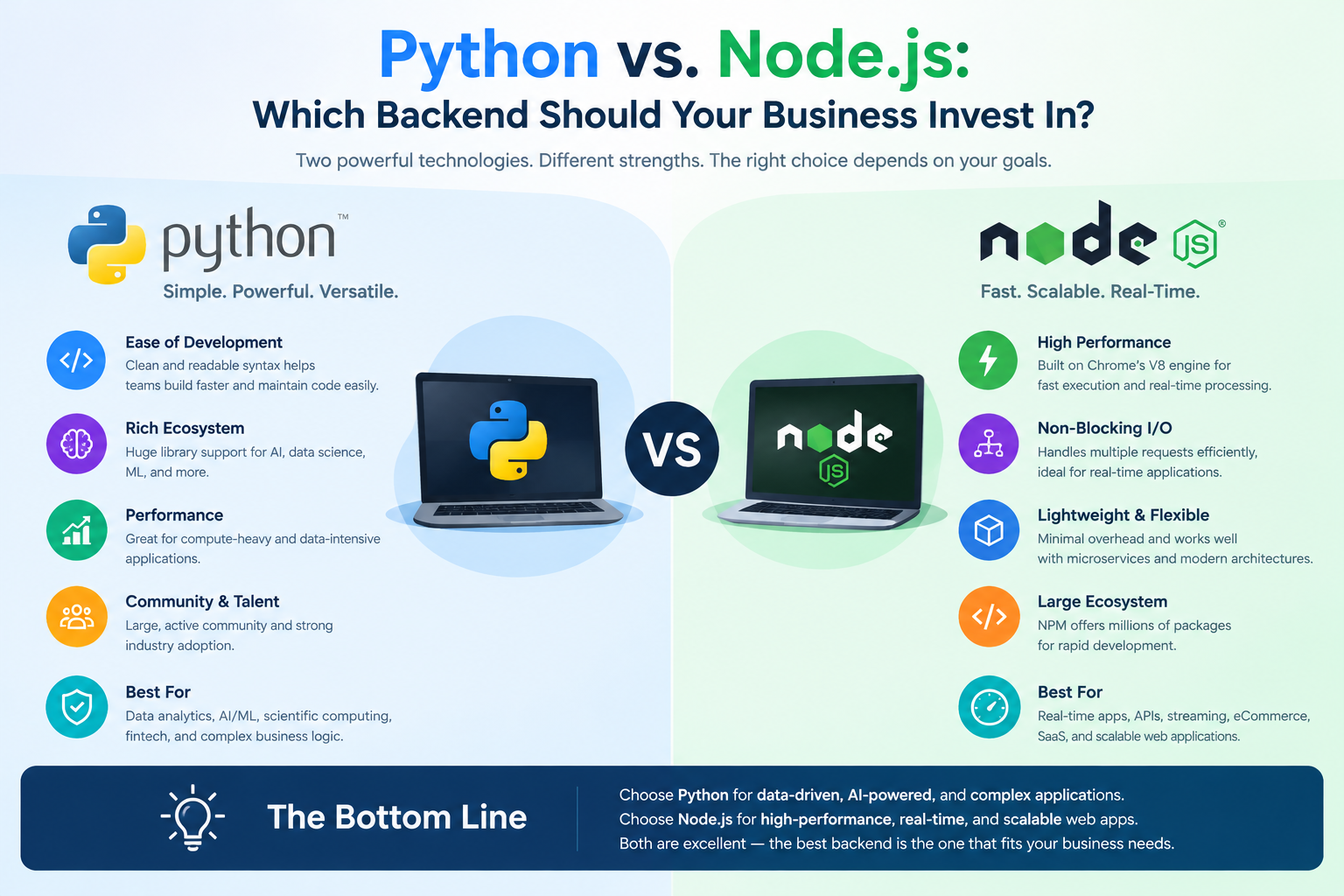
Use Python if your backend relies heavily on artificial intelligence, machine learning, data processing or automation. Use Node.js when you're looking for real-time capabilities, APIs that can handle lots of concurrent users, and a single JavaScript stack for front and back end development. Authored by iKnowledge's staff, How to Do It with Python is a three-volume set of tutorials designed to help you start coding in Python.How to Do It with Python is a three-volume collection of tutorials written by the staff of iKnowledge that will get you started with Python programming.
Let's take a look at a side by side view before we dive into more detail:
Factor | Python | Node.js |
Primary strength | Artificial Intelligence / Machine Learning / Data / Automation | Real-time, high-concurrency I/O |
Performance model | Efficient for computations workloads | Highly sought after for numerous connections at once. |
AI and ML ecosystem | Industry standard | Limited, sometimes accesses Python services |
Learning curve | Gentle, readable syntax | It is easy to use for JavaScript teams. |
Common frameworks | Django, FastAPI, Flask | Express, NestJS, Fastify |
Best for | Artificial intelligence products, analytics, and fintech. | Develop chat apps, stream, APIs, microservices |
Talent pool | Large and growing | Over-sized, front-end talent |
They are able to run large scale modern web applications. The difference is seen in where each feels comfortable and where you end up battling with the tooling.
What is Python and what does it have to offer?
Clean and readable syntax and an extensive library ecosystem are the hallmarks of Python, a general-purpose programming language. It drives everything from web apps and APIs to data pipelines, scientific computing and almost any big AI and machine learning framework used today.
For backends, frameworks such as Django, FastAPI, and Flask provide a quick route to production for teams. In particular, FastAPI has emerged as a go-to option for AI-driven APIs, thanks to its rapid performance and its seamless support for asynchronous operations.
Best Use Cases for Python in 2026
- AI and machine learning products such as model training, inference pipelines, retrieval pipelines
- Data-driven platforms, analytics and reporting dashboards
- Automation and scripting (such as agentic AI workflows that call tools and external APIs)
- The areas of fintech, healthtech, and anywhere else data science is in close contact with the product.
- Rapid prototyping and MVPs when looking for speed are most important.When developer speed is the most important, rapid prototyping and MVPs are most important.
Python is not the wrong choice if you're looking at incorporating AI into your product strategy. The ecosystem benefit is significant and only intensifies as your AI journey unfolds.
What is Node.js and where does it triumph?
A runtime for writing server-side code using JavaScript. Being event driven, non-blocking, it is a good choice for many concurrent connections with low overhead, so it is frequently used in real-time and high-traffic systems.
Having a common language between the front end and back end can make it easier to hire and work together, and tools such as Express, NestJS and Fastify provide structure for the team.
Best Use Cases For NodeJS
- Real-time applications like chat, live dashboards and collaboration tools
- Applications or streaming applications that constantly send and receive messages between the client and the server.Applications or streaming applications with continuous client-server communication.
- REST and GraphQL APIs with high concurrency.High concurrency REST and GraphQL APIs.
- Light weight services that require quick start-up and need to scale horizontally, like microservices.
- Teams that wish to use one language throughout the entire stack, JavaScript or TypeScript
When computation is not the limiting part of the application, Node.js is the better option to use for input and output operations. If you've got a light workload that makes a lot of requests, it's difficult to top.
Python vs. Node.js: A Practical Head-to-Head
Performance and concurrency. Node.js is also optimized to process a large number of concurrent I/O operations due to its non-blocking event loop. While Python has narrowed the gap with other frameworks such as FastAPI that rely on async programming paradigms, Node.js still has one advantage when it comes to raw, high-volume socket programming. Python is also better suited for compute-intensive or data-intensive applications, with its well-established scientific and numerical libraries.
Scalability. Works well on larger scale in production. Node.js scales horizontally with microservices, and is a popular choice for distributed, request-driven systems. Python fits too, and the majority of big AI platforms support Python services running behind load balancers and queues.
Ecosystem and libraries. Here the two are at odds the most. Python is the king of the AI, data science and machine learning scene. Teams often find that they call a Python service for models, embeddings, or data pipelines, since the massive package registry and great web tooling of Node.js is not enough.
Talent and hiring. Both boast sizeable talent base. There's a lot of JavaScript and TypeScript developers to assist those who use Node.js. The talent pool for Python developers is also rich, and skilled AI programmers are among them, so it is becoming a wise business decision to hire Python programmers who are also experienced with AI.
How 2026 AI Trends Impact Backend Selection.The Impact of 2026 AI Trends on Backend Selection.
This comparison a couple of years ago was primarily focused on performance and developer preference. AI is now the focal point of the discussion and it tips the scales in 2026.
The rise of Agentic AI and Autonomous Workflows.The emergence of Agentic AI and Autonomous Workflows.
Agentic AI, in which software agents plan, call and execute multi-step tasks with minimal human effort, is an emerging mainstream trait for product teams. Agent frameworks, orchestration tools, and libraries for calling tools are typically created in the Python programming language. If you're on a journey of autonomous agents, workflow automation, or AI copilots, Python will keep you close to the ecosystem rather than bridging into it.
Enterprise AI Adoption and Automation
AI is no longer just an experiment in enterprise usage, but now has become a vital part of business. Businesses are integrating AI into their customer service, document handling, predictions and internal automation. These systems are strongly based on Python, as it is where the models, data tooling and integration libraries reside. The choice of the backend language is a part of the AI strategy, not the main one.
The Rise of AI-Native Backends
The so-called AI-native backend will become more common in 2026, where retrieval, model calls, and data processing will be as integral as part of the application itself. This type of architecture is the natural home of Python. The edge of these types of systems, where user facing APIs and real-time delivery requirements exist, still works well with Node.js, and that's the reason most contemporary stacks couple the two: Node.js at the front door, Python behind the door doing the AI work.
The following are some of the factors that need to be taken into consideration before choosing.
Follow these questions to make a clear decision:
- What is the most important function that your product serves? AI, data, and automation show that Python is the way.AI, data, and automation have pointed to Python. If you need to deliver code in real-time and have high concurrency requirements, then APIs will lead you to Node.js.
- What does your vision of an AI roadmap entail? When it comes to AI, Python lowers the barriers in the present or the next couple of years.When it comes to AI, Python simplifies the process.
- What skills does your team already have? A good JavaScript team can deliver quickly using Node.js.
- What's your launch speed? Both of them are able to develop quickly, and Python's readability can often accelerate early development.
- What size does your business need to grow to? Create your plan for your largest traffic volume and your biggest data volume, and not only the launch.
- What do you intend to do when you hire? Take into account the availability, expenses, and if only AI-specialized engineers are required.
- How much money do you have to spend? Consider future costs for AI integration, development, and maintenance.
In many companies, the answer is, "both" — in the ways that each does best.
When deciding how to hire Python developers, cost and talent are essential to consider.
This is as much a budget / talent decision as it is a technical one. While Python is an affordable option for development and talent is abundant, the price ranges significantly depending on location, experience, and expertise in AI. Standard CRUD will cost less for an engineer that can build it, than a retrieval pipeline and a model that can be deployed in production.
In general, businesses have three options – building their own team, hiring freelancers, or collaborating with a dedicated Python development company. In-house teams provide you with control, but require time and investment. Freelancers are flexible, but unpredictable. When partnering with established Python developers, you get vetted developers, proven processes and AI experience without the length of time it takes to build a team.
As you examine Python development services and top Python development companies, consider the experience they have in AI and machine learning projects, their engagement model, effective communication, and their portfolio that aligns with your domain. These signals are more important than headline hourly rates.
When to use Python, When to use Node.js
The easiest way to resolve it:
If you're developing an AI or machine learning product, a data or analytics platform, an automation or agentic AI system, or a fintech or healthtech product with data science at the heart of the business, then Python is the better choice.
If you are developing a real-time application, a streaming or chat application, a high-concurrency API layer, or a microservices application that is quickening your development team, opt for Node.js.
Select both for user-facing, real-time delivery in Node.js, and AI, data, and automation in Python. This mix is becoming more prevalent in today's AI-ready architectures.
Final Verdict
There's no overall victor and some serious consideration gives that admission. Node.js is great for real-time, I/O-centric applications and teams that prefer to work with JavaScript. For companies where the future hinges on AI, data, and automation—businesses account for a substantial and expanding number in 2026—the future is safer with Python.
With a focus on AI and agentic workflows, or data-rich features, Python provides you with a base that remains relevant to the industry's future. The next step is to partner that decision with the appropriate team. It doesn't matter if you grow your own or if you're partnering with a Python development company, you need to find a business partner that understands solid engineering as well as the AI abilities that your business will rely on in the future.
Frequently Asked Questions
For backend, is Python superior to Node.js? There is no one right or wrong. Python is more powerful for AI, machine learning, data processing, and automation. For real-time applications and high-concurrency APIs, the Node.js is more powerful. This is where it becomes crucial to select the right option based on your product objectives and AI journey.
So which is faster Python or Node.js? Usually, node.js is able to process a lot of concurrent I/O operations quicker due to its non-blocking event loop. Python offers scientific and AI libraries that make it faster and more powerful in compute-heavy and data-heavy applications. The term "faster" is dependent on the load.
How about using Python in the AI and machine learning backends? Yes. Python is the most common programming language in the field of AI and machine learning. Almost all major model frameworks, data tools and agentic AI libraries are originally for Python, making it the language of choice for AI-based backends.
In 2026, should I hire Python developers or Node.js developers? If your product requires the use of Artificial Intelligence, data or automation, recruit Python software developers with machine learning expertise. In the real-time delivery arena or the JavaScript stack, the Node.js developers fit the bill. Most teams employ both.
Is it possible to use Python together with Node.js? Yes, and many modern systems do! One typical configuration is to have Node.js for front-end app development with APIs that require real-time API access, and Python for the back-end for automating tasks and data processing as well as for AI tasks. They complement each other nicely.
What is the price of Python developers? The cost will vary based on region, seniority and specialization. Python experts with AI expertise are more expensive than backend developers. By comparing python development services or with a dedicated Python development company, you can be certain with predictable pricing or vested talent.
Comments
Join the discussionNo comments yet. Be the first to comment.