
What to Look for in a Python Development Company Today
Most companies shopping for a Python development company right now aren't really shopping for Python. They're shopping for AI. They want a support bot that actually knows their product catalog, a pipeline that reads invoices without a human retyping them, or an internal assistant that can answer questions from five years of scattered documentation. Python is the language that makes nearly all of that possible, which is why the line between a Python vendor and an AI integration company has mostly disappeared.
So the real question gets narrower: which teams can deliver AI Integration Services that hold up once real users and real data hit them? If you're weighing a top AI integration company against a cheaper generalist shop, or reading through lists of the Top AI Integration Companies for 2026, this guide covers what I'd check before signing anything. Picking the right AI integration partner gets much easier once you know what good looks like, and if you want names to start with, the Top 10 AI Integration Companies roundup is a solid place to begin.
The Short Answer: What Should You Look for in a Python Development Company?
Look for a Python development company with shipped, production AI systems (not just demos), strong data engineering skills, hands-on experience with LLM APIs and open-source models, a clear testing and evaluation process, documented security and compliance practices, post-launch monitoring, and transparent pricing. The best AI integration partners can show you working systems and let you speak to the clients who use them.
That's the version for people in a hurry. The rest of this article explains why each of those matters and how to spot the difference between a team that can do the work and a team that has simply added "AI" to its homepage.
Why Python Sits at the Center of AI Integration Services
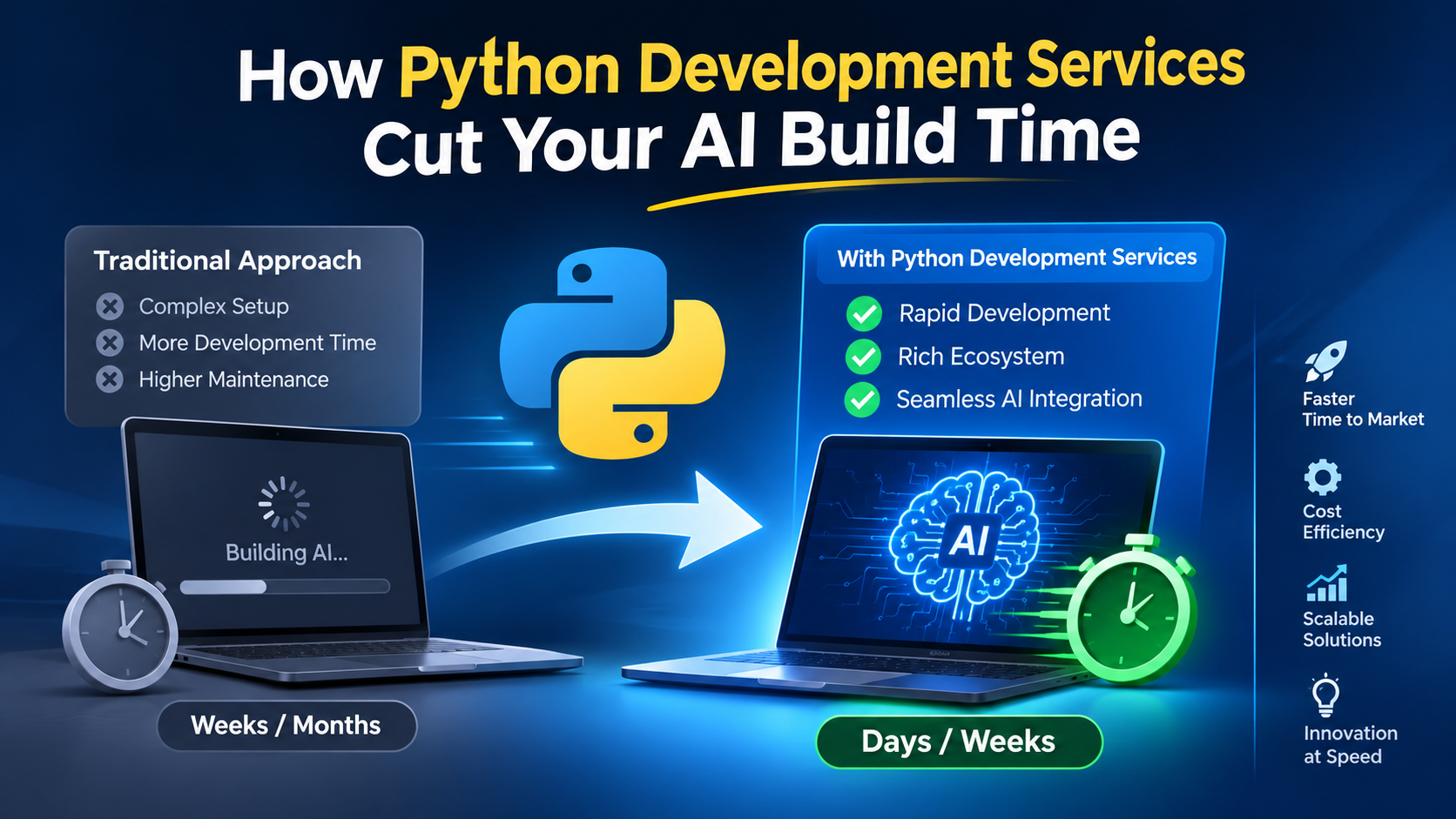
Python isn't the only language in AI, but it's the one the whole ecosystem orbits around. GitHub's Octoverse report showed Python overtaking JavaScript as the most-used language on the platform in 2024, and the jump was driven largely by AI and data science work. The official SDKs from OpenAI, Anthropic and Google ship Python support first. PyTorch, Hugging Face Transformers, scikit-learn, LangChain, LlamaIndex and FastAPI are all Python-native.
Here's the catch, though. Being good at Python doesn't make a team good at AI. I've seen plenty of agencies with excellent Django portfolios that struggle the moment a project involves embeddings, vector search or prompt evaluation. Python fluency is the entry ticket. It's not proof of anything else.
When you evaluate a vendor, treat their Python skills as a baseline and spend most of your time on the AI-specific questions below.
What Does an AI Integration Company Actually Do?
An AI integration company connects AI models, such as large language models, machine learning models, computer vision or speech systems, to your existing software, data and workflows so they work inside the tools your team already uses.
In practice, the model itself is a small slice of the job. Most of the effort goes into the unglamorous parts: cleaning and structuring data, building retrieval pipelines, handling user permissions so the AI doesn't show a sales rep the CFO's files, managing latency, controlling cost per request, writing fallbacks for when the model gets something wrong, and setting up monitoring so you know when quality slips.
If a vendor's proposal is 80% about which model they'll use and 20% about everything else, I'd read that as a warning sign. In my experience it should be closer to the opposite.
9 Things That Separate a Top AI Integration Company From the Rest
- Production AI work you can verify Demos are cheap now. Anyone can wire up a chatbot over a weekend. What you want is evidence of systems that have run in production for months, with real users, real edge cases and real support tickets. Ask for case studies with numbers, and ask to speak to at least one client whose project went live more than six months ago. How a system behaves after launch tells you far more than how it looked in the pitch.
- Data engineering depth AI output is only as good as the data behind it. A strong AI integration partner will ask about your data before they ask about your budget: where it lives, how clean it is, who owns it, how often it changes. If nobody on their side brings up data quality in the first two calls, they're either inexperienced or planning to discover the problem on your dime.
- Model-agnostic thinking The model you start with probably won't be the model you use in two years. Prices drop, new releases arrive every few months, and open-weight models like Llama, Mistral and Qwen keep closing the gap with closed ones. A good partner designs an architecture where swapping models is a configuration change, not a rebuild. Be wary of any team that's locked into one provider because that's the only one they know.
- A real evaluation process This is the factor I'd weigh most heavily, and it's the one most buyers skip. Ask a simple question: "How will we know the AI is giving correct answers?" A mature team will talk about test datasets built from your real queries, automated evaluation runs, hallucination checks, regression testing when prompts change, and human review loops. A weak team will say something like "we'll test it thoroughly." That's not a process. That's a hope.
- Security, privacy and compliance AI systems touch sensitive data by default, so this can't be an afterthought. Look for SOC 2 or ISO 27001 practices, clear data handling agreements, role-based access controls built into retrieval, and an understanding of rules that apply to you. Depending on your market, that might mean GDPR, HIPAA, India's Digital Personal Data Protection Act, or the EU AI Act, whose obligations are phasing in over 2025 and 2026. Ask them directly whether your data will be used to train any third-party model and how they prevent it.
- Comfort with your existing stack Your AI feature has to talk to your CRM, ERP, ticketing system, internal APIs and maybe a database that predates half your team. The best Python teams are strong integrators first. Ask how they've handled legacy systems before, and listen for specifics. "We built a connector to a 2009-era SOAP API" is a much better answer than "we work with all major platforms."
- LLMOps and post-launch support Launch day is where AI projects begin, not where they end. Models drift, user behavior changes, and costs can creep up quietly when usage grows. Ask what monitoring they set up, what dashboards you'll get, how they track cost per query, and what their support agreement looks like after go-live. If the answer is "we hand over the code," plan for a second vendor later.
- Honest scoping and pricing A trustworthy partner will often suggest starting smaller than you planned. A focused proof of concept over four to eight weeks, with clear success metrics, tells both sides whether the idea works before anyone commits to a big build. Fixed-price, time-and-materials and dedicated-team models all have their place. What matters is that the vendor explains the tradeoffs instead of pushing whichever model pays them best.
- The people who'll actually do the work
Sales calls are often run by the most senior people in the company. Then the project gets handed to someone else entirely. Ask to meet the actual engineers, check whether they've shipped AI work before, and ask about team retention. A team that churns every six months will lose context on your system just as it starts getting good.
Strong Partner vs. Weak Vendor at a Glance
What you ask | Strong AI integration partner | Weak vendor |
"Show us past AI work" | Live systems, client references, metrics | Demos and screenshots |
"How do you measure accuracy?" | Eval datasets, automated tests, human review | "We test thoroughly" |
"What about our data?" | Detailed questions in the first call | Brought up mid-project |
"Which model will you use?" | "Depends; here's how we'd decide and switch" | One provider, every time |
"What happens after launch?" | Monitoring, cost tracking, support plan | Code handover |
AI Integration Trends in 2026 That Should Shape Your Choice
The market has moved fast over the past eighteen months, and a few shifts should influence who you hire.
Agentic workflows are moving into real operations. Companies aren't just asking AI to answer questions anymore. They're asking it to take actions: update records, draft and route documents, trigger workflows. That raises the bar on permissions, audit trails and failure handling. A partner who has only built Q&A chatbots may not be ready for this.
Standard connector layers are maturing. The Model Context Protocol, introduced by Anthropic in late 2024 and adopted across OpenAI, Google and Microsoft tooling during 2025, has made it much simpler to connect AI models to business tools in a consistent way. Ask vendors whether they build with MCP or similar standards. Custom one-off connectors are harder to maintain.
Smaller and open models are winning specific jobs. For classification, extraction and routing, a smaller model running on your own infrastructure is often cheaper, faster and easier to keep private than a frontier model. A good partner will mix model sizes based on the task.
Cost governance is now a design requirement. Plenty of teams discovered in 2025 that their pilot cost a few hundred dollars a month and their production rollout cost tens of thousands. Caching, model routing and usage limits should be in the architecture from day one.
Regulation is getting specific. Between the EU AI Act timelines and tighter data protection laws in India, the US states and elsewhere, compliance has become part of the build, not a review at the end.
Real-World Lessons: What Happens When AI Integration Goes Right and Wrong
Two well-known cases explain the stakes better than any checklist.
In early 2024, Klarna announced that its OpenAI-powered assistant was handling around two-thirds of its customer service chats within its first month, doing work the company compared to roughly 700 full-time agents. It was a genuine success on efficiency. But by 2025, Klarna's CEO publicly acknowledged that the company had leaned too hard on cost-cutting and that service quality had suffered, and Klarna started bringing human agents back into the mix. The lesson isn't that AI failed. It's that the integration needed a better human handoff design from the start. A good partner plans for the cases the AI shouldn't handle.
The second case is smaller but sharper. In February 2024, a Canadian tribunal ruled that Air Canada was liable for incorrect bereavement fare information its website chatbot had given a customer. The airline argued, in effect, that the chatbot was responsible for its own words. The tribunal didn't accept that. The amount was modest, but the precedent wasn't: if your AI says it, you own it. That's exactly why retrieval grounding, answer validation and guardrails matter, and why you should hire a team that takes them seriously.
Red flags worth walking away from
Be cautious with any vendor that promises 100% accuracy, since no honest team can. The same goes for vendors who recommend fine-tuning a custom model for every problem when retrieval or better prompting would do the job for a fraction of the cost. Watch for proposals with no evaluation plan, teams that can't estimate cost per request, and anyone who seems uninterested in how your business actually runs. Good AI integration starts with understanding the workflow, not the model.
How to Shortlist an AI Integration Partner in 5 Steps
- Define one clear use case. Pick a single problem with measurable value, like cutting ticket response time or automating invoice processing.
- Build a longlist of six to ten firms. Curated lists such as these top 10 AI integration companies to watch in 2026 save a lot of early research.
- Run a structured first call. Use the nine factors above and note who asks about your data and success metrics.
- Ask for a paid discovery or proof of concept. A few weeks of real work reveals more than any proposal deck.
- Check references and meet the delivery team. Talk to past clients and the engineers who'd actually build your system.
The questions I'd bring to every first call are simple. What's the most similar system you've put into production? How would you measure whether this works? What would make you tell us not to build this? That last one is my favorite. A partner who can't name a reason to say no probably isn't thinking hard enough about yes.
Frequently Asked Questions
What are AI integration services?
AI integration services are the work of connecting AI models, like large language models, machine learning models or computer vision tools, to a company's existing software, data and processes. This usually includes data preparation, building retrieval or automation pipelines, API integration, security controls, testing and ongoing monitoring.
How do I choose the right AI integration company?
Choose an AI integration company based on verified production work, data engineering skill, a clear evaluation process, security and compliance practices, flexibility across AI models, and post-launch support. Start with a small proof of concept and speak to past clients before committing to a large project.
How much do AI integration services cost?
Costs vary widely with scope. A focused proof of concept is usually the cheapest way in and often runs for four to eight weeks. Full production systems cost more because they include integration with existing tools, security work, testing and monitoring. Ask vendors to separate build costs from ongoing model usage and support costs.
How long does an AI integration project take?
A proof of concept typically takes four to eight weeks. A production-ready system often takes three to six months, depending on data readiness, the number of systems involved and compliance requirements.
Why is Python used for AI integration?
Python is the most widely supported language for AI. Major model providers release Python SDKs first, and core AI libraries like PyTorch, Hugging Face Transformers, LangChain and LlamaIndex are built for Python. That makes Python teams faster at building, testing and maintaining AI systems.
Should I build an in-house AI team or hire an AI integration partner?
If AI is central to your product long term, building in-house capability makes sense eventually. For most startups and mid-market companies, hiring an AI integration partner first is faster and less risky. It gets a working system live and helps you learn which skills are worth hiring for permanently.
What is the difference between an AI integration company and a regular software agency?
A regular software agency builds applications. A top AI integration company also handles the AI-specific problems: model selection, retrieval design, evaluation, hallucination control, cost management and model monitoring. Many agencies claim AI experience, so ask for production examples to confirm it.
Final Thoughts
Choosing a Python development company today is really a decision about who you trust to put AI into your business without breaking what already works. The flashiest demo won't tell you that. The questions about data, evaluation, cost and what happens after launch will.
If you're building a shortlist, start with the use case, keep the first project small, and favor the team that asks better questions than you do. For a researched starting point, take a look at our guide to the Top AI Integration Companies for 2026. And for what it's worth, this checklist is the same one the Python and AI engineers at WebClues Infotech hold themselves to on client projects. If you'd like a second opinion on a use case you're considering, we're always happy to talk it through.
\
Comments
Join the discussionNo comments yet. Be the first to comment.